Letters in Spatial and Resource Sciences

post-image

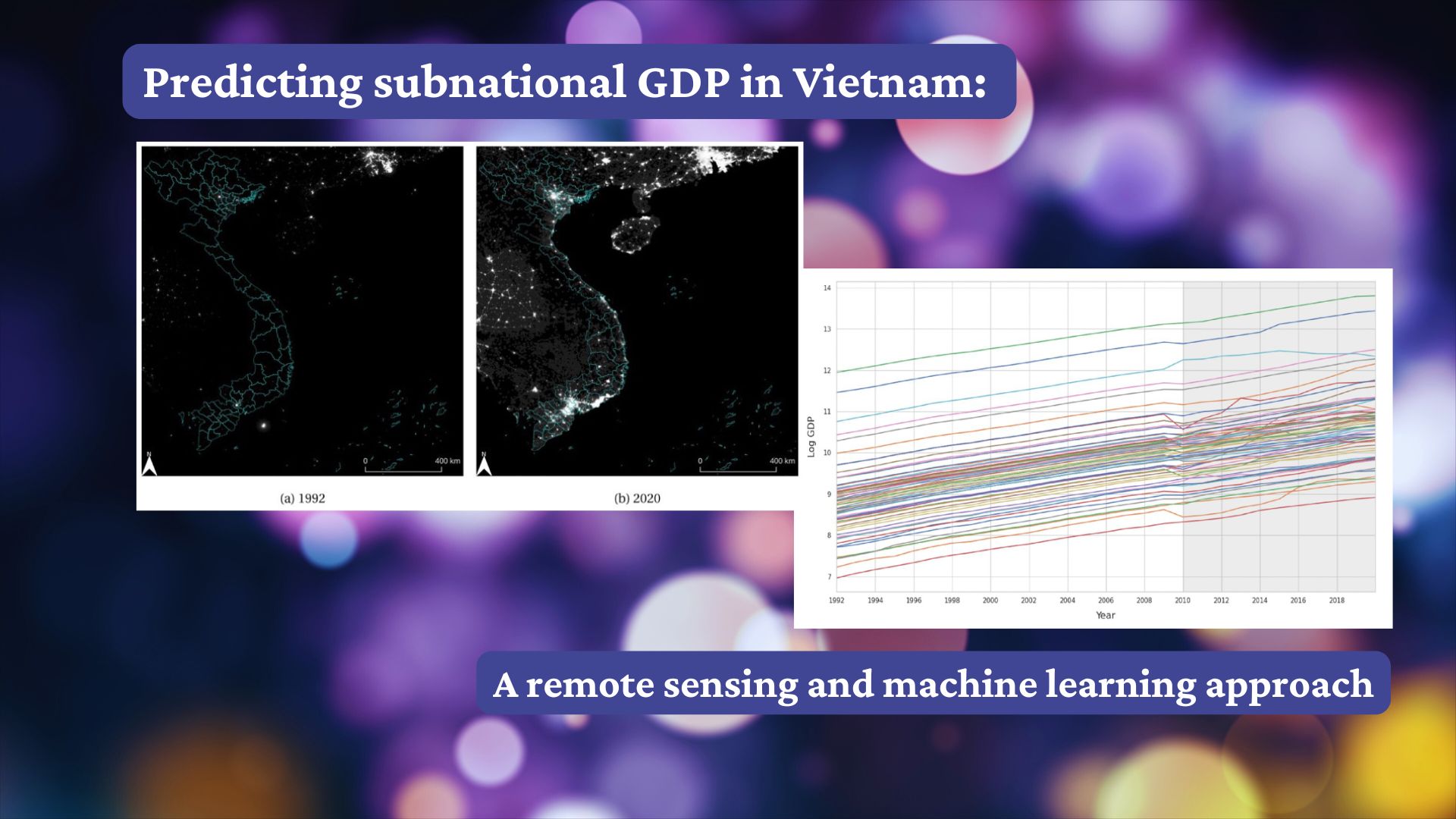
Predicting subnational GDP in Vietnam with remote sensing data: A machine learning approach

Thursday, Mar 20, 2025 by Hussein Suleiman, Minh-Thu Thi Nguyen and Carlos Mendez Letters in Spatial and Resource Sciences

Official subnational Gross Domestic Product (GDP) data in Vietnam has been available only since 2010, hindering the analysis of long-term dynamics of local development. Based on remote sensing data and machine learning methods, we construct a subnational GDP indicator for the 63 Vietnamese provinces from 1992 to 2009. Specifically, we rely on nighttime lights (NTL), agricultural land, and climate datasets and employ six machine learning algorithms to construct the GDP dataset.

Continue Reading
post-image

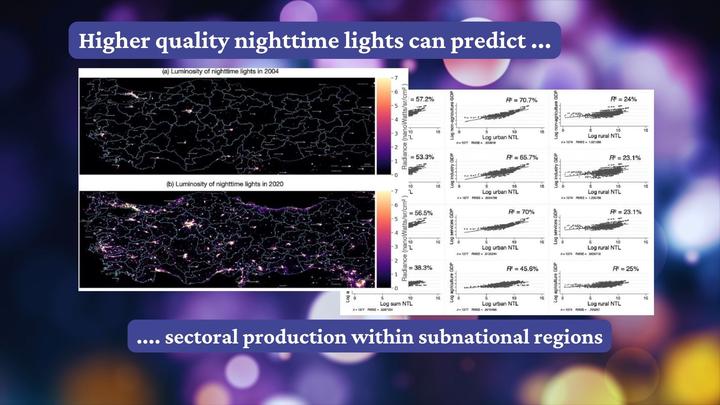
Can higher-quality nighttime lights predict sectoral GDP across subnational regions? Urban and rural luminosity across provinces in Türkiye

Sunday, Apr 7, 2024 by Yilin Chen, Ugur Ursavas and Carlos Mendez Letters in Spatial and Resource Sciences

This study investigates whether improved nighttime light data can forecast economic output by sector within regions. Analyzing 81 Turkish provinces from 2004 to 2020, we found that urban NTL data is most strongly correlated with non-agricultural GDP, particularly in the industrial sector. The findings suggest luminosity measurements could help policymakers identify economically disadvantaged areas, assess development initiatives, and direct funding appropriately. However, the research notes constraints in tracking yearly GDP fluctuations, underscoring the importance of combining satellite imagery with supplementary economic metrics for thorough analysis.

Continue Reading
post-image

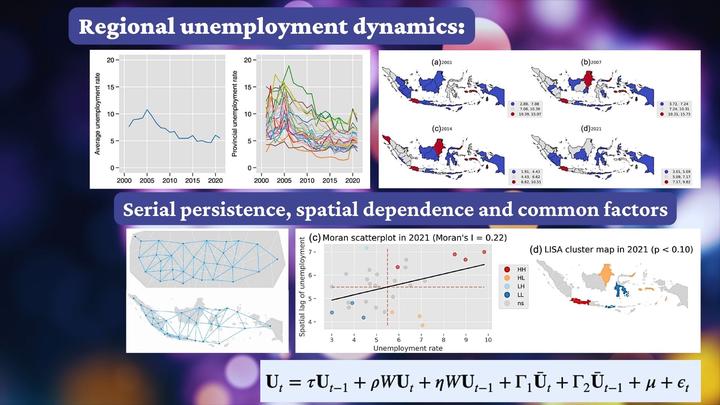
Regional unemployment dynamics in Indonesia: Serial persistence, spatial dependence, and common factors

Sunday, Nov 26, 2023 by Carlos Mendez and Tifani Siregar Letters in Spatial and Resource Sciences

We analyze the space-time dynamics of Indonesia’s provincial unemployment by simultaneously accounting for their serial persistence, spatial dependence, and common factors. The results show that unemployment rates vary widely across provinces, but have similar patterns over time, indicating the presence of common latent factors. Using the average national unemployment rate as a proxy for common factors, the results indicate that the space-time dynamics of provincial unemployment are characterized by both significant serial persistence and spatial dependence.

Continue Reading
post-image

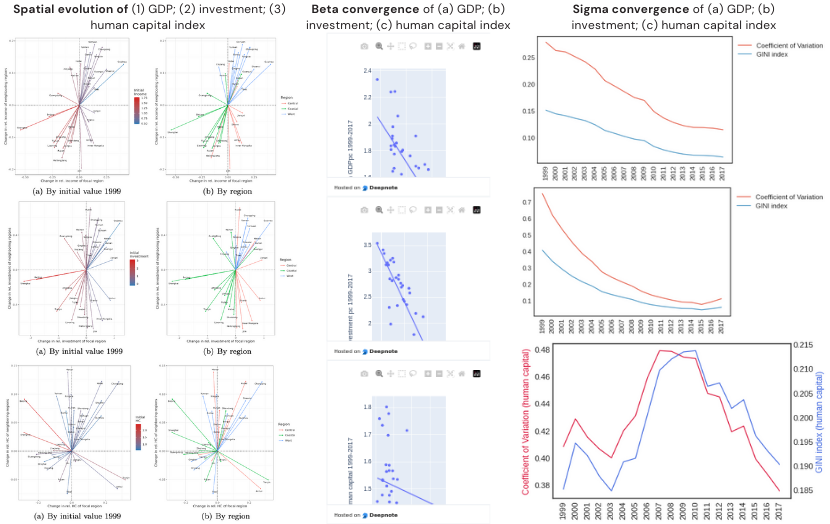
Investigating regional income convergence in China: an exploratory spatio-temporal perspective

Tuesday, Apr 18, 2023 by Yilin Chen, Dohèto Othniel Kpoviessi and Harry Aginta Letters in Spatial and Resource Sciences

Uneven regional development has become an issue in China since the Open and Reform Policy in the 1980s. The imbalance can be observed as the “coastal-west divide” in previous convergence studies. This paper aims to investigate the convergence of income and its determinants across Chinese provinces from 1999 to 2017 by including the role of space. Our findings from a new exploratory technique in spatial analysis show convergence in income and investment but not in human capital, which is in line with results from non-spatial classical convergence models.

Continue Reading

Do you conduct similar research?

Join our research and learning community

JOIN US