GeoJournal

Living with disadvantages: how does healthcare professional inequality spatially affect NCD mortality in Thailand?

Sunday, Jun 1, 2025 by Katikar Tipayalai and Chayaton Subchavaroj GeoJournal

This paper maps the spatial distribution and clustering of non-communicable-disease (NCD) mortality and healthcare professionals across Thailand’s 77 provinces over a ten-year period and uses spatial econometric models to assess whether the distribution of healthcare professionals affects NCD mortality, finding a positive spatial association attributed to reverse causality and confounding.

Continue Reading

How does inclusion of digital finance, financial technology, and digital literacy unlock the regional economy across districts in Sumatra? A spatial heterogeneity and sentiment analysis

Wednesday, Jun 26, 2024 by Ragdad Cani Miranti, Sabar I. Siregar and Ade B. Willyana GeoJournal

Using district-level nightlight and digitalization data for 2019-2022 with Geographically Weighted Regression, this paper shows that digital finance, financial technology, and digital literacy have positive but spatially heterogeneous effects on the regional economy across the districts of Sumatra.

Continue Reading

Examining the impact of digital financial inclusion on economic development in urban and rural areas of China using remote sensing

Monday, Jan 1, 2024 by Jiaqi Li GeoJournal

The expansion and penetration of digital financial inclusion have provided new impetus to economic development. With the aim of investigating the non-spatial and spatial effects of digital financial inclusion on urban and rural economic development, we target 31 provinces from 2011 to 2019 and complement the research gap by processing luminosity-corrected GDP and land cover images to generate urban and rural GDP statistics. This study highlights the following conclusions: first, digital financial inclusion has positively localized effects on rural economic development.

Continue Reading
post-image

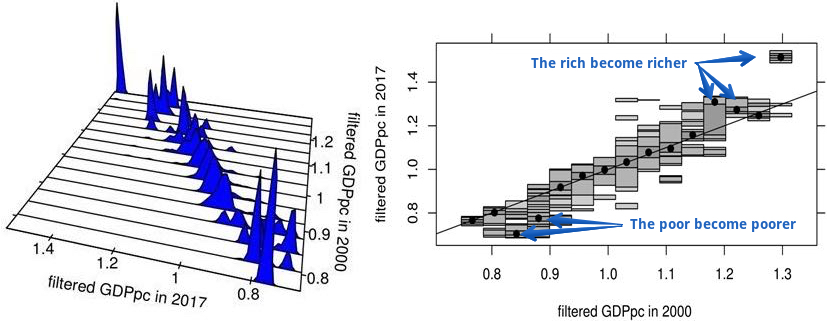
Regional Income Disparities, Distributional Convergence, and Spatial Effects:District-Level Evidence from Indonesia 2000-2017

Monday, Jan 11, 2021 by Carlos Mendez, Anang Budi Gunawan, and Felipe Santos-Marquez GeoJournal

Using a novel dataset constructed for this study, the spatio temporal dynamics of income per capita across 34 provinces and 514 districts in Indonesia over the 2010-2017 period are analyzed. First, an exploratory spatial analysis suggests that spatial autocorrelation is only significant at the district level, and it appears to be robust from 2013 to 2017. Consequently, at this level, a spatial filtering model is used for decomposing income into a spatially independent component and a spatial residual.

Continue Reading
Do you conduct similar research?

Join our research and learning community

JOIN US