Economies

post-image

Lack of Global Convergence and the Formation of Multiple Welfare Clubs across Countries: An Unsupervised Machine Learning Approach

Thursday, Oct 10, 2019 by Carlos Mendez Economies

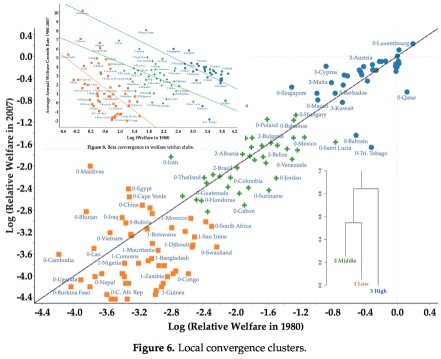
The cross-country convergence hypothesis is one of the central topics of long-run macroeconomics. This paper revisits this hypothesis in a context beyond GDP. It uses a novel welfare index that incorporates measures of consumption, leisure, life expectancy, and inequality. Based on a sample of 128 countries over the 1980–2007 period, the lack of global sigma and beta convergence is first documented. Next, the paper incorporates some recent developments from the unsupervised machine learning literature to evaluate the existence of local convergence.

Continue Reading
post-image

Industrial Productivity Divergence and Input-Output Network Structures: Evidence from Japan 1973–2012

Friday, May 31, 2019 by Alvaro Dominguez and Carlos Mendez Economies

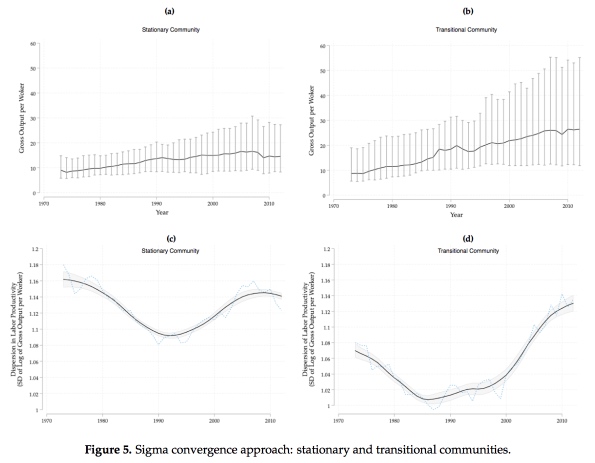
Since the early 1990s, there have been larger and increasing labor productivity differences across industries in Japan. More specifically, a clear pattern of sigma and beta divergence across industries is observed. To shed light on these stylized facts, we first evaluate the input–output structure of Japan through the lens of a community-detection algorithm from network theory. Results from this analysis suggest the existence of two input–output network structures: a densely-connected group of industries (a stationary community), whose members remain in it throughout the period; and a group of industries (a transitional community) whose members do not belong to this first group.

Continue Reading

Do you conduct similar research?

Join our research and learning community

JOIN US