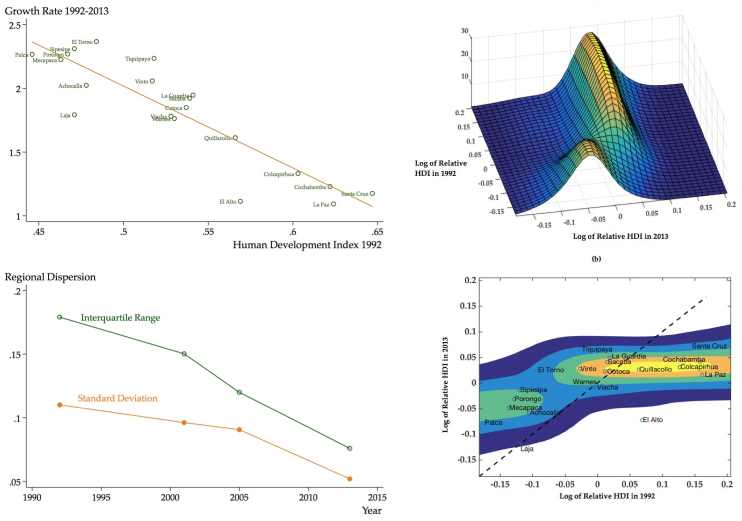
Almost half of the population of Bolivia currently lives in the metropolitan regions of La Paz, Santa Cruz, and Cochabamba. Motivated by the potential for growth and development of these regions, this article documents the evolution of their human development differences over the 1992-2013 period. In particular, using the United Nations' human development index at the municipal level, this paper evaluates the process of regional convergence through the lens of three frameworks: beta, sigma, and distributional convergence. The overall result is an increasing tendency toward convergence that is driven by both slower forward mobility of the less developed regions and faster backward mobility of the more developed regions. The distributional convergence framework provides further insights and suggests that the formation and merging of multiple convergence clusters is a salient feature of inequality reduction. Furthermore, in the long-run, convergence appears to be characterized by the transformation of a trimodal distribution into a left–skewed unimodal distribution. The article concludes emphasizing that the cross-regional distribution of human development in Bolivia is quite sticky at its left tail and, as a result, the least developed regions are still relatively far from achieving complete convergence in the long run.